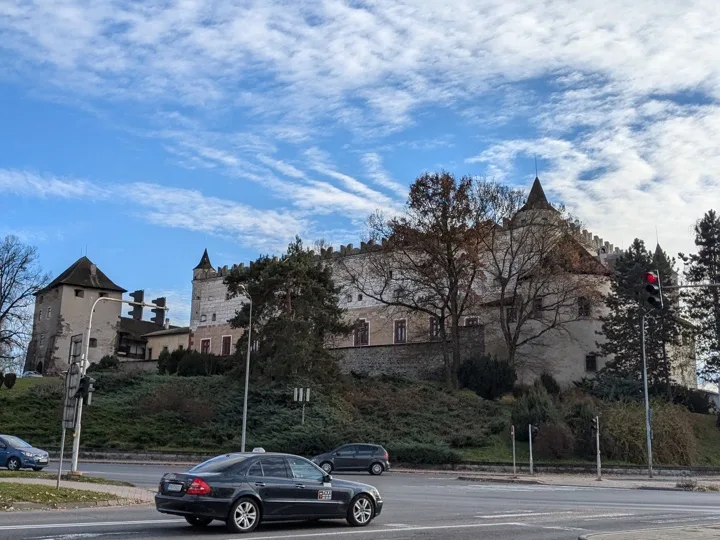
One of the largest medieval castle ruins in Central Europe
Divided into an Upper and Lower Castle, the site is now mostly walls and foundations rather than intact rooms, but the scale alone makes it one of the most memorable ruins in Slovakia. The climb up is as much part of the experience as the ruins themselves.
What to look for during your visit
5 highlightsWalk a hilltop ruin covering roughly 76,000 square metres
Trace stonework linked to twelfth-century King Béla III
See the thirteenth-century fortifications built by stonemason Bertold
Compare the scale to Spiš Castle, one of Central Europe's largest
Combine the hike with wide views over the Hron and Slatina valleys
A place shaped across centuries
In the thirteenth century, following the Mongol invasions that devastated much of the region, the stonemason Bertold significantly expanded and fortified the site to better protect the people of Zvolen from future incursions. That expansion is largely what gives Pustý hrad its exceptional scale today — comparable to Spiš Castle, one of the largest castle complexes in the whole of Central Europe.
What to expect when you arrive
Treat this as a hike with historical rewards rather than a quick castle stop: the walk itself, through forest and open hilltop terrain, is as central to the visit as the stonework.
Plan your visit
960 01, Zvolen
The ruins are an open-air site accessible at any time, with no ticket or admission gate. Access can be limited after heavy rain, snow or ice, since the approach is an unpaved forest trail.
Spring and autumn offer the most comfortable hiking temperatures and the clearest views once the trees thin out. Avoid the trail shortly after heavy rain, when the unpaved path can become slippery.
The marked trail to Pustý hrad begins on the edge of Zvolen and climbs through forest to the hilltop site; allow around 45–60 minutes uphill at a steady pace. There is no public transport directly to the trailhead, so most visitors walk or drive from central Zvolen.
The site is not accessible for visitors with limited mobility. The trail is unpaved forest terrain with sustained elevation gain, and the ruins themselves involve uneven ground, loose stone and no barriers at drops.
There are no visitor facilities on site — no café, toilets or shelter — so plan accordingly before setting out. Wear sturdy footwear suited to a forest trail with some elevation gain, and check the weather forecast, since the hilltop location is exposed to wind.